
About
I am a Ph.D. student in Computer Science at the Golisano College of Computing and Information Sciences, Rochester Institute of Technology, advised by Prof. Lingwei Chen. Before RIT, I received my B.S. in Computer Science from the Advanced Program in Computer Science (APCS) at VNUHCM – University of Science in Vietnam, where I worked with Prof. Minh-Triet Tran.
My research focuses on what happens to large language models after pre-training. How do we compress them into smaller students, make them forget data they should not keep, and fine-tune them without inheriting hidden backdoors? My approach is to first find the mechanism behind a method’s success or failure, often through gradient or spectral analysis, and then design a fix that follows from it. Before moving to LLMs, I worked on the theory of sharpness-aware minimization.
Research
Knowledge Distillation
How temperature and the choice of divergence shape what a small model learns from a large one.
Machine Unlearning
Making fine-tuned LLMs forget specific training data while keeping everything else they know.
Robust Fine-Tuning
Why parameter-efficient fine-tuning fails to remove backdoors, and how to make it work.
Optimization Theory
Sharpness-aware minimization, from convergence guarantees to robustness against noisy labels.
News
| Aug 2026 | Our paper Rethinking the Role of Temperature in Large Language Model Distillation has been accepted to the EMNLP 2026 main conference. |
|---|---|
| May 2026 | New preprint: Consistently Informative Soft-Label Temperature for Knowledge Distillation is now on arXiv. |
| Apr 2026 | Our paper Why LoRA Fails to Forget: Regularized Low-Rank Adaptation Against Backdoors in Language Models has been accepted to Findings of ACL 2026. |
| Mar 2026 | New preprint: Diversity-Aware Reverse Kullback-Leibler Divergence for Large Language Model Distillation is now on arXiv. |
| Jan 2026 | Our paper Understanding SAM’s Robustness to Noisy Labels through Gradient Down-weighting has been accepted to AISTATS 2026. |
Selected Publications
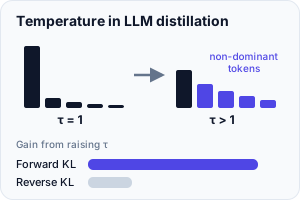
- Rethinking the Role of Temperature in Large Language Model DistillationIn Conference on Empirical Methods in Natural Language Processing (EMNLP), Main Conference, Short Paper, 2026Key idea The common verdict that reverse KL beats forward KL for LLM distillation was measured at temperature 1. We show that temperature injects signal from non-dominant tokens into forward KL but mostly just rescales reverse-KL gradients. With a well-chosen temperature, forward KL overtakes reverse KL, and simple KL objectives gain up to +6.6 ROUGE-L, competitive with recent state-of-the-art methods.
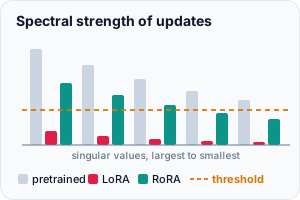
- Why LoRA Fails to Forget: Regularized Low-Rank Adaptation Against Backdoors in Language ModelsIn Findings of the Association for Computational Linguistics (ACL Findings), 2026Key idea Fine-tuning a backdoored model with LoRA on clean data rarely removes the backdoor. We show the cause is spectral rather than just low rank: LoRA updates have singular values far below those of the pretrained weights and align with the wrong directions. RoRA raises spectral strength and corrects the alignment, lowering attack success while keeping clean accuracy.
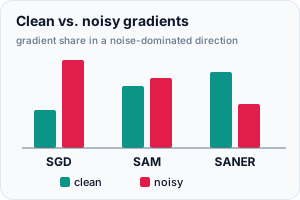
- Understanding SAM’s Robustness to Noisy Labels through Gradient Down-weightingIn International Conference on Artificial Intelligence and Statistics (AISTATS), 2026Key idea Why is SAM robust to noisy labels? Looking at each parameter, when noisy gradients dominate a direction, SAM amplifies the clean gradients more strongly, which down-weights the noisy ones. SANER makes this effect explicit, slowing the memorization of noisy labels and beating both SAM and SGD. It also plugs into other SAM variants.
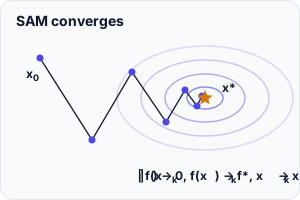
- Fundamental Convergence Analysis of Sharpness-Aware MinimizationIn Advances in Neural Information Processing Systems (NeurIPS), 2024Key idea SAM is widely used, but its basic convergence was not fully understood. We prove that the gradients go to zero, the function values reach the optimal value, and the iterates converge to a solution. Because the proof uses an inexact gradient descent framework, it also covers VaSSO, RSAM and USAM.




Education
- Ph.D. in Computer Science 2025 – presentRochester Institute of Technology · Rochester, NY, USAGolisano College of Computing and Information Sciences · Advisor Prof. Lingwei Chen
- B.S. in Computer Science 2020 – 2024VNUHCM – University of Science · Ho Chi Minh City, VietnamAdvanced Program in Computer Science (APCS) · GPA 3.82/4.00